Monday, June 18, 2012

Llama Biography #6: Little May Flowers

I'm terrible at remembering to take pictures when I'm out doing things with the llamas, but I'm really going to try harder!  Until I have some cool new pictures to talk about, I'll share another of our wonderful llamas with you.

Little May Flowers, Spring 2005.

The sixth llama to join our herd was Little May Flowers, aka May.  She was the first cria born on our farm.  April (Alder Crest April Showers) gave birth to May on May 9th, 2000.  We came home after school that night and found May laying in the poop pile!  She started off looking a little rough, but she quickly grew into a gorgeous little girl.  She had the most gorgeous fiber too!


Little May Flowers, Summer 2000.

May's dam, Alder Crest April Showers.

May's sire, Taj's California Sun.

May wearing a bandana, Summer 2000.

May's gorgeous locked fiber, Spring 2005.

May was also the first cria that I got to train from the very beginning.  Luckily I had learned a lot about training with Sheba, so May got off to a good start.  Once May was a year old, I showed her in 4-H and open shows.  We did pretty well together, especially the second year.

May's first show, Spring 2001.  We won Showmanship!

May's first show, wearing her gypsy costume.  We won the class too!

May and I at the 2002 Indy Open show.  We won Showmanship and placed well in performance.

Another costume...May was such a good sport!  Summer 2002.

May and I after winning Showmanship at the 2002 Indiana State Fair!

May and I at the 2002 Great Lakes Regional.  We were 2nd in Showmanship!

Once May was 2.5 yrs old, we decided to retire her from showing and let her be a mom.  We bred her to a beautiful white male (SHAG Guido), and 11 months later she gave us a little boy, Autumn Hill's Blazing Starr.  May wasn't real sure about being a mom for a few days and we had to bottle feed Blaze, but she caught on eventually.  Blaze went on to grow into one of the nicest crias we've ever had.  His little sister gave him a run for his money though!  Autumn Hill's Trillium, sired by our (then) new herdsire Randallama's Cherokee, was a fabulous little girl.  We bred May one more time, this time to our younger herdsire, AAL Navarro.  We were a little disappointed with the resulting cria, Autumn Hill's Camissia, but she grew up quite nice.  Shortly after Camissia was born, we sold May and Camissia to be alpaca guards.  May was bred back to Cherokee, and had another gorgeous little boy.  I'm still sad that I sold her!

May's first cria, Autumn Hill's Blazing Starr.  Winter 2003.

May's second cria, Autumn Hill's Trillium.  Fall 2005.

May and Trillium.  Talk about a carbon copy!

May's third cria, Autumn Hill's Camissia.

May and her final cria.

Sunday, June 3, 2012

Halter Training

I've been busy playing with the llamas for the past few weeks, and have completely forgotten my blog!  But I'm back, and thought I would talk a bit about halter training, since that's what I've been doing with our new cria, Kara.

Most people tend to wait til the cria is 3-6 months old to halter train, but I've always had better luck starting much earlier.  I like to start at 1-2 weeks of age, and always go slow.  Crias that young don't have much of an attention span, but they're usually very willing and absorb training like a little sponge!

Autumn Hill's Trillium, Catastrophie, and Inali, with Inali's dam, Alder Crest April Showers, in the background.  All 3 crias were halter and performance trained at an early age, and Inali went on to be a Performance Champion in 4-H.
First I start just letting the cria wear the halter around the pasture, not bothering to attach a lead rope.  Make sure to use a tiny cria halter- a halter that is too large can pose a hazard to the cria.  Most crias will shake their head and not move much at first.  I usually wait until the cria is walking around and behaving normally (trying to graze or nurse is a good sign that they are comfortable with the halter on) before taking the halter off.  Repeat this as many times as possible, leaving the halter on for 5-15 minutes, until the cria is completely comfortable wearing the halter.

Autumn Hill's Karakoram wearing her halter for the first time.  1 week of age.
Next I'll start leading the cria around with the mom.  The cria will want to follow its mom, so it won't fight the pressure on the lead.  I usually only do this once or twice, but would do it more if the next step didn't go well.  Again, limit this to 5-15 minutes of training.

SHAG Cattera and her 3 month old son Autumn Hill's Catallegre walking around the front yard. 
Then I will start taking the cria out on their own.  I like to start just by walking the cria around the pasture they are in, so that I'm not adding more stress by putting them in a new environment.  I usually will walk 1-2 laps around the pasture, depending on their behavior.  Repeat this until the cria knows to follow you and will respond to gentle pressure on the lead rope.

Little May Flowers sporting a bandanna (training for a later costume).  2 months of age.
And finally you can take the cria on walks in new environments.  Start slowly, and never have the cria out more than 15 minutes at a time.  You can start teaching the cria to stand still as well.


Autumn Hill's Charity expertly standing to have her picture taken.  1 month of age.

Once the cria is walking well on lead and responding as an adult would, there's no reason you can't start with more advanced training.  I have obstacle trained crias as early as 2 weeks of age!  A well behaved, halter-trained cria is going to be safer if you take them off the farm for any reason- I've safely taken 2 week old crias to shows and to other farms (to rebreed their moms).  Crias put up much less of a fight when they are trained at a younger age, and typically become better behaved adults.

Overman Bluff & Fluff and her 3 month old cria, Autumn Hill's Rainier, at the 2009 Indiana State Fair.  Rainier showed in 2 classes with Bluff at the show, including costume where he wore a modified dog pack.  Rainier has since gone on to place well in huge novice performance classes for his new owner.

Oh, and last but not least, I took a video of Kara during her first halter session.


Tuesday, May 8, 2012

Summer is here!! (And a new cria!)

Well the semester is finally over, so I can get back to my life!  Luckily I get to spend the summer back home on the farm, so I promise there will be lots of llama and fiber-related posts!

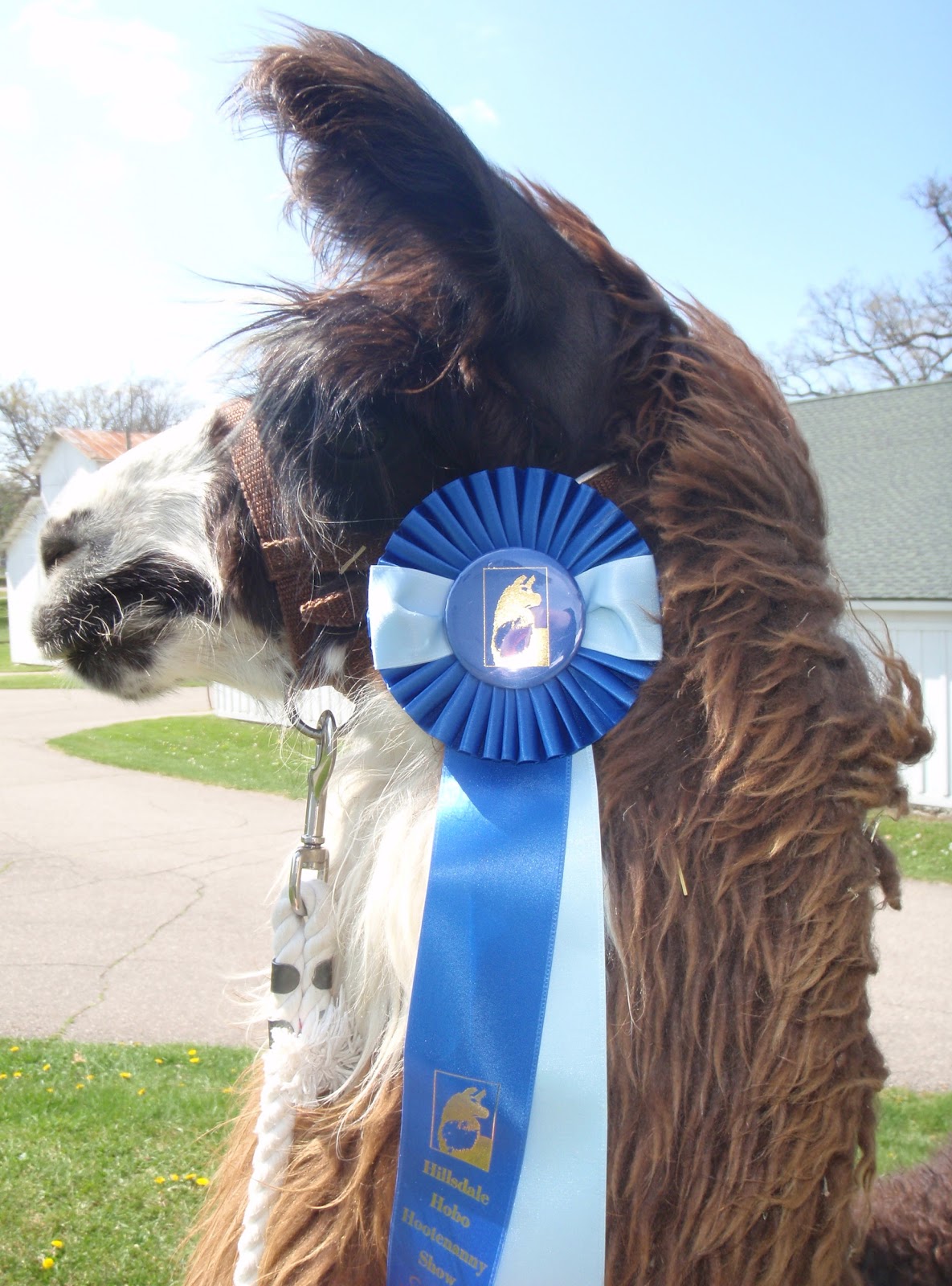
First, results from the Hillsdale Hobo show, our 2012 show season opener!  T and Ralph both did very well for hardly being worked with all winter (my fault, I know!).  T was really freaked out in showmanship for some reason, and I forgot a vital part of the showmanship "pattern" (I forgot to smooth down T's wool after the judge pet him), so we didn't place.  The class was competitive though.  I guess we both need some practice before the state fair!  Halter was awesome though.  T won his class (of 4)- Yearling Non-Breeder.  He didn't get Grand or Reserve, but he didn't behave very well either.  He did compete in Get of Sire for his previous owners though, and they placed second in a very competitive class.  Both boys did great in performance (for them!), doing obstacles I never thought they'd do.  And Ralph finally decided the dreaded stuffed moose wouldn't kill him!  Took 4 years!  Oh, and Ralph got his haircut!

Can you say curls?  I can't wait to shear T!

T modeling his 1st place ribbon!

Such a handsome boy.  I'm really getting attached!

Ralph modeling his new haircut.  His head definitely needs work, and I haven't decided if I should try to trim his legs more or not.  Though after how Bluff's shear job turned out this weekend I probably shouldn't bother!

And next, a puppy update.  Abby has been spoiled the past couple of weeks, and we've gone on some cool hikes.  One up in Lansing, and another in Indianapolis.

The first hike was at an old brick factory!

Hiking down the trail. 
Abby modeling her new Easy Walk harness.  She reacts to it a lot better than the Halti or Gentle Leader head halters, and it works almost as well.

I have a feeling this is an old quarry.

Abby was getting rather pooped!

Turtle!  One jumped into the river just before I took the picture.

The trails follow the Grand River in Grand Ledge, MI.

The second walk was at Fort Benjamin Harrison in Indianapolis.  Kaya (Australian Shepherd) got to join Abby for this one!

My sister and I are planning on taking our two dogs (she has a rescued German Shepherd/Border Collie (?) mix) on a bunch of hikes this summer to get them both socialized.  Abby is definitely over-socialized and needs to calm down around people, while my sister's dog Cerro needs to realize people aren't scary.  Hopefully they can both find a happy medium!

I ended up going home over the weekend, and quickly became knee-deep in llama stuff!  Bluff finally had her cria on the 29th of April, a beautiful little girl my sister delivered and named Autumn Hill's Karakoram (aka Kara).  Apparently Kara's legs were twisted around her head, and my sister calmly figured out the situation and straightened her out.  She's doing great now, and gaining over 1.5 lbs daily thanks to Bluff's amazing milk supply!

Newborn Kara.  She started out at 30 lbs!

Kara at 1 week of age.  Up to 40 lbs already!

Since the cria was delivered and the weather was back in the high 80s, we decided Bluff needed a haircut.  So we carefully groomed her out and gave her a bath Saturday morning, and then started shearing her later that night.  I'm having some clipper problems, so we had to finish up on Sunday.  I knew Bluff would be nervous being in the chute (away from her cria), so we groomed her in the creep feeder with Kara at her side.  We then let Kara loose in the front yard while I washed Bluff, and then they both spent the afternoon in a pen under the barn overhang.  I even sheared 90% of Bluff in the creep feeder, just tied loosely to the fence!  I did eventually have to put her in the chute to finish her belly and legs, but by Sunday Kara nor Bluff were nervous about being separated.  That bodes well for showing them at the state fair in August!

Bluff getting her toenails trimmed before we started grooming.

Gotta love a calm momma llama...Kara was nursing on and off the whole time we were grooming Bluff!  And Bluff was never tied up.

The *before* shot.

The *after* shot- part 1.  She still looks a bit rough here (Saturday night).  She looks better now (I evened her up Sunday), but I still have to finish her back legs.
In fiber news, I finally finished my llama show vest!  It needs buttons and a band in the back to cinch it in a bit, but otherwise I'm very happy with how it turned out.

Hopefully it won't look as frumpy in person!

Close-up of the cable pattern and button band on the front of the vest.  I love the tweedy look of this yarn.
So that's about it for now.  Abby and I are back in Michigan for one last week, then home until late August!  I have lots planned for Kara, T, and Ralph!  And of course tons of state fair projects to work on.  Should be a great summer!

Sunday, April 15, 2012

Crias!

No, no cria from Bluff yet, but all this waiting gave me the idea to write about what to expect when a cria is born and what supplies to have on hand.

Ralph saying hello to Cattera's newborn cria, Catallegre.

Hands down, crias are my favorite part of raising llamas!  There's nothing cuter than a fuzzy little baby llama!  And after waiting ~11.5 months, their birth tends to be a big deal on most farms.

Catastrophie standing proud over her newborn cria, Annapurna.

Llamas are very stoic animals, and this applies to birthing as well.  With most females, you will have no idea when they are going to deliver.  I like to watch udders, but you have to know your particular female(s).  I have had some females who won't produce milk until the day they deliver, while others (including Bluff) will have a full udder for a month or two before they are due.  When I had multiple females due every year I would keep a record of when they started to develop an udder, and then use that information the next year to try and determine when they would actually deliver.  Some alpaca breeders swear by checking the ligaments around the tail- they should soften the day of delivery.  Another possible sign is a relaxed vulva- it will look a lot bigger and even show the pink lining when birth is imminent.  Some females will go off by themselves to deliver.  I had one female who wouldn't ever deliver when someone was home!

This can be a bad sign- lying on their side with the back legs thrown out to the side.  This is Bluff (pregnant with her first cria), who was experiencing a uterine torsion.

This is a normal sign: a relaxed vulva.

When birth is really near, most females will get up and lie down repeatedly.  They'll visit the potty pile a lot, but won't actually go to the bathroom.  Sometimes they will shift from side to side when they are lying down.  You may actually see the water break, or you may just see the nose and toes appear!  If everything is going right, you want to see the head and two front legs first.  If you have anything other than the head and both front legs, CALL YOUR VET!  Delivery tends to stall at this point for a few minutes, don't be worried if the cria just dangles there.  It's good so that the fluid can drain out of the cria's nasal passages.  If there is any membrane around the cria's nose or mouth, go ahead and remove that.  It normally won't take more than 15-30 minutes for the shoulders and the rest of the cria to be delivered- if it is much more than that, you might want to call the vet or assist the dam yourself.

Once the cria is delivered, stand back and let mom and baby bond for a few minutes.  The cria will thrash around a bit in an attempt to kush upright or even stand.  As long as the cria is breathing and moving around, you don't have anything to worry about immediately.  After a few minutes (or right away if it is particularly wet or cold), try to sneak in and dry off the cria.  Some dams will freak out if you try to mess with their crias, while others have no problem.  Just be cautious and watch your particular female.  Pretty soon the cria will try to stand.  You'll want to dip or spray the navel with 7% iodine or novalsan right away, and at least a few more times that day and the next.  If the umbilical cord is particularly long, you may want to tie it up so that it doesn't get stepped on or ripped.  It should fall off in a few days.

Cattera and her newborn cria, Cataleya.

Now that the cria is standing, it will start looking around for the milk bar.  Most crias will try to nurse every possible spot on the dam before they find the right spot.  I tend to let the cria explore on their own for 15-30 minutes, but if they still haven't latched on by that point I will steer them in the right direction.  Again, hopefully the dam will let you assist.  Crias nurse a bit differently than most people would expect- they switch between nipples rather quickly (I believe it is something like every 3 seconds they will switch), and don't nurse for very long at a time (normally no longer than a minute or two).  You can check the cria's lips for milk residue to tell if they have been nursing successfully.  The cria needs to nurse in the first 6 hours to get the beneficial colostrum.

May allowing her cria, Camissia, to nurse.  Notice how May's tail is wrapped- we like to do this a week or two before the female is due, as it helps keep them clean during delivery and makes it easier for us to see what is going on back there.  Camissia's ears are also taped- they were very floppy at birth.

After the cria has nursed, you can do a bit more hands-on examination.  Make sure the teeth have erupted (no teeth is a sign of prematurity), and you can stick your little finger in their mouth to check for a good suck reflex (a weak suck reflex can cause nursing problems).  Droopy ears or weak pasterns are other signs of prematurity.  You may want to take the cria's temperature- normal is 100-101F.  You'll definitely want to weigh the cria at some point.  Normal birth weight can range from 20-35lbs.  The important thing is to weigh the cria at the same time every day for at least a week- the cria should gain between 0.5-2lbs a day.  Any weight loss or stalling of weight gain should be talked over with a vet.

A perfect example of droopy ears.  All of May's crias were born with ears like this (actually May herself was too!), I believe it was partly genetic, partly because they all were somewhat premature.  We routinely would tape up droopy ears to help them hold shape.

Within 1-6 hours, the dam should deliver the placenta or afterbirth.  If this doesn't occur within 24 hours or the placenta doesn't look to be in one piece, CALL THE VET!  Whatever you do, don't pull on the placenta!  We learned this the hard way!  Some dams are really uncomfortable until the placenta passes, and won't let the cria nurse until then.  As long as it doesn't take more than 5-6 hours, don't worry too much.

Catastrophie with her first cria, McKinley.  Alpacas Alejandro and Moreo look curiously at the new addition.

Depending on the weather, time of day, and your female, you can put the mom and baby in a stall, or leave them in the pasture to continue bonding.  If its raining, cold, or almost dark, we'll normally go ahead and bring them in the barn.  Otherwise just leave them outside.  If you have any pushy individuals in your herd, you might want to put them in the barn or a different pasture.  We like to keep the mom and baby in the barn at night for the first few nights (less if the weather is nice, normally at least 2 nights).  We bed a stall down with straw, and add water and hay for the dam (plus some grain).  Make sure there isn't anything the cria can get into.  If the weather is cold but dry, you can use a cria coat (or a child's vest) to keep the cria warm.

Catastrophie and her second cria, Annapurna.  Annie was born in late September, and wore a coat on and off her first winter.

Some people like to give an enema to the cria within a few hours of birth, to help them pass the meconium (first feces).  We don't do this anymore, unless the cria doesn't pass the meconium within 24 hours or appears weak or lethargic or is straining.

A very tired Catallegre laying in the pasture with his mom, Cattera.  Being born is a lot of work!

You'll want to continue dipping the navel for another day, monitor nursing, and weigh the cria daily for at least a week.  Make sure the cria pees and poops (it is not uncommon for the cria to have a thick, yellow feces for awhile, especially if the dam is a heavy milker- however, if this turns into persistent diarrhea, call the vet).

Bluff letting her first cria, Rainier, nurse.  Bluff is an extremely heavy milker, and both of her crias experienced "mustard poop" on and off for their first few weeks of life.

Now all that's left is to sit back and enjoy your healthy cria!  I'll try to post stories of some of our llama births over the years.  No birth is ever the same!  I apologize for not having birthing sequence photos to show, but they are all in hard copy and I don't have a scanner!  There are tons of great websites with photos though!

April keeping watch over the fall 2005 crop of crias (L-R: Trillium, Catastrophie, Inali).

Oh, and our list of cria supplies:
             Powdered colostrum
             20 oz. plastic pop bottle (washed out)

 Red Pritchard nipples
 Baby bottles and nipples
 Enema
 KY jelly
 Thermometer
 Bulb aspirator
 Novalsan/iodine
 Film canisters w/ lids (washed out)
 Cotton gauze pads
 Clean towels
 Digital scale & sling
 Cria coat
 NurseMate (colostrum paste)
 Electrolytes
 Cria books

One of my favorite photos...3 generations!  The brown cria is McKinley, his mom is the appy (Catastrophie), and Taz's mom is the brown/silver girl sniffing the cria (Cattera).