Showing posts with label shearing. Show all posts

Thursday, May 16, 2013

Shearing Part 2!

Well, I managed to get a LOT of pictures of the process of shearing Kara, which I talked about in length in the last post.  Now you get to see the rest of the herd!

I'll warn you, I'm not the best shearer in the world.  Plus none of my animals are going to shows this year (boo!), so they don't have to look super-awesome!

First to set the scene...This was the view from our front yard back in Indiana, the first week of May.  It was gorgeous, but it did rain more than I'd like.  Hence I had to get 5 llamas shorn in 3 days!


Next, the "before" shots...

Kara was by far the dirtiest (maybe T...it was close!).

Bluff has nice white fleece that somehow always stays clean.  She was easy!

This guy was a nightmare!  On top of everything I body sheared him, so I tried getting his neck and legs clean, which was a lost cause.

Good old Ralph and April...  Poor Ralphie hasn't been shorn yet.  I thought I had an alpaca breeder lined up to shear him, but it seems to have fallen through.  Now it looks like a llama breeder friend is going to shear him!  And you can't see April's barrel, but is is ALWAYS clean!  Normally it is wasted since I don't use her fiber, but not this year!  I actually groomed and washed her like the rest of the llamas (though I forgot to blow her out), and am going to have her fiber (along with part of Ralph's and Bluff's) made into felted insoles for shoes!  Such a cool idea!

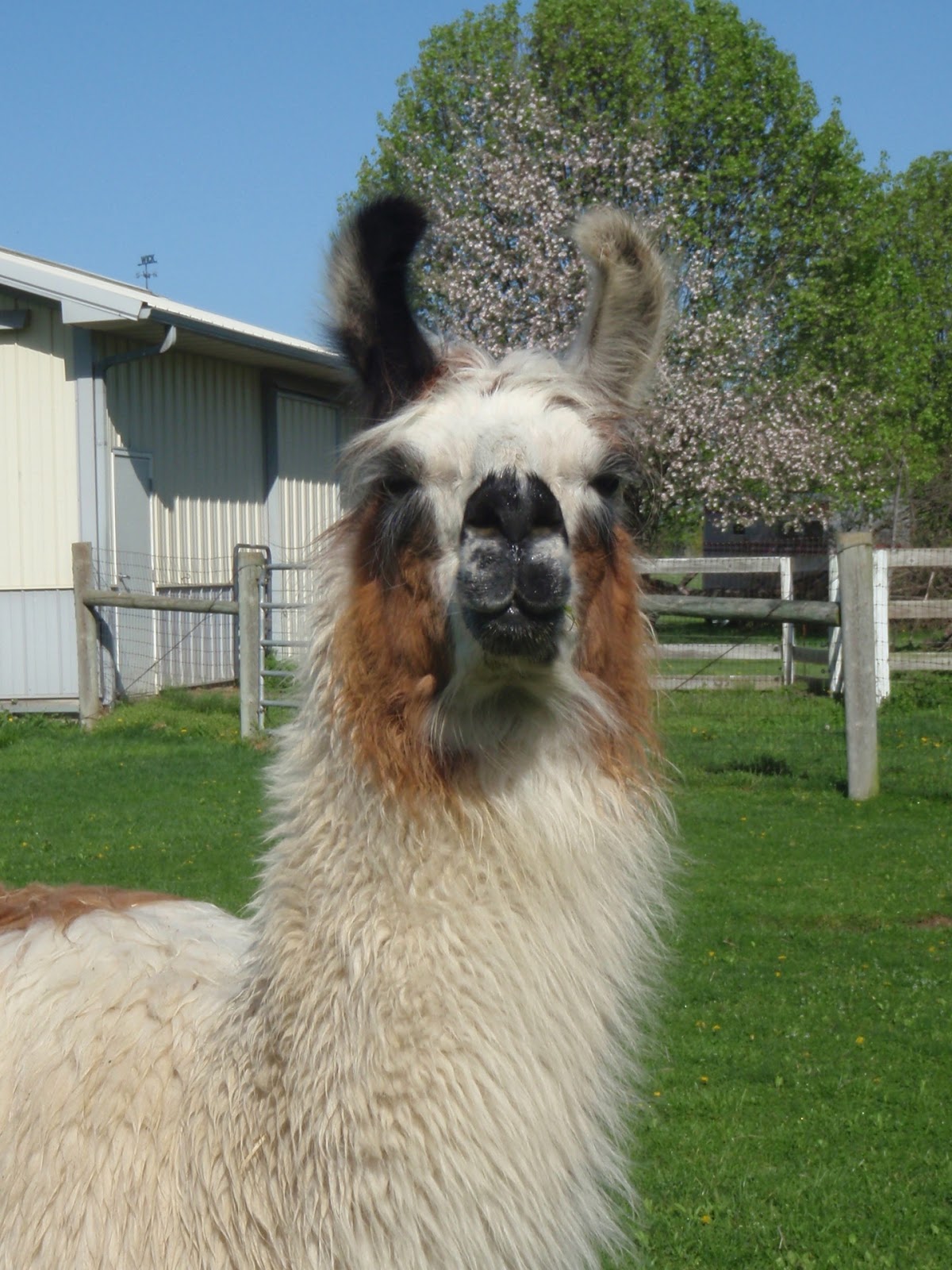
And last but not least, Duque!  Like Bluff he stays pretty clean (the one upside of double-coated llamas!), and he is very easy to clean.

Duque's gorgeous fleece, after a bit of grooming.

Here's Bluff after grooming, waiting for her bath.

Now to the "after" shots!

Poor Duque got the worst haircut!  In a month you'll never know how terrible it looked at the beginning though!

April looks pretty good if I say so myself.  Even though she really didn't want to cooperate for some reason...

Beautiful "baby" Kara.  Her cut wasn't as good as I hoped, but it is nearly impossible to get a smooth cut with such a fine fleece!  She feels a lot better now though, and that's the most important part!

Bluff is the only one with a really nice cut.  There are a few rough spots, but again in a month she'll look awesome!  She will probably be shown by her new owner, so I wanted her to look good!  This is the first time in several years that I haven't body shorn Bluff...she's moving to New Hampshire in June, so she won't have the Indiana heat and humidity to deal with.

And last but certainly not least...Mr. T.  By most people's standards he probably got the worst haircut, but I think he looks awesome!  His neck and legs were incredibly matted, so I wanted to get that fiber off.  Now I can body shear him every year and use 100% of his gorgeous fiber!  The funny patch on his side is for walking fleece shows, even though he won't be going to any this year unfortunately.

Now I have lots of bags of beautiful llama fiber to play with!  I explained already what I'm going to do with April's fiber.  Duque and Bluff's fiber (from this year and last year) is going to get blended with a purchased alpaca fleece and a purchased Bluefaced Leicester (sheep) fleece, and get made into a grey roving.  Kara's will be spun into yarn that has been pre-purchased, and T's fleece was also pre-sold and has already been sent to the lucky recipient!  Ralph's fleece is pre-sold as well, and will go out this fall.

Saturday, May 11, 2013

Shearing A Llama: Kara's 1st Haircut!

FINALLY I'm back in the land of camera-computer cords, and can update the blog!  I spent the past week back home in Indiana on the farm, and took lots of pictures as I was busy grooming, washing, and shearing llamas, but I somehow managed to forget the cord that connects the camera to the computer, and thus I couldn't share any of them!  But I'm back in New York now, and want to show off my naked llamas!

But first, the story of a baby llama's first haircut...

In case you don't remember her from previous posts, this is Kara (aka Autumn Hill's Karakoram).  She's the last baby llama we had born on the farm- she was born April 29, 2012.  She's been growing a beautiful fleece for the past year, which even won 2nd place at a llama show last fall (in walking fleece, which is judged on the llama).  It's been getting hot in the Midwest though, so Kara was more than ready to get rid of her heavy fleece.

This is baby Kara, the day she was born.

This is (a very wet-nosed) Kara, looking very grown up at just over a year old.

The first thing that had to be done was lots and LOTS of grooming!  Kara LOVES to get dirty, and her fleece really showed it.  Over the course of 2-3 days, I spent several hours brushing Kara.  Luckily she has her mom's sweet and manageable personality, so most of this was done with her loose in the training pen in our barn (as opposed to being tied in the chute so she doesn't move).  I brushed out the surface of her fleece, which had most of the dirt and grass, and then dug in deep and worked through every other inch of her barrel (belly) area!  I like to use a soft slicker brush when I groom, it gets a lot of debris out, and doesn't seem to pull the fiber.

Kara, BEFORE any grooming!

Grooming Kara out in the training pen.  She laid down about half-way through, but that's still not bad!
The second step was to blow the dirt and dust out of her fleece with a high power blower.  Kara had never had this done to her before, but luckily was very well behaved for it.  (A lot of babies freak out the first time they are blown out!)

Blowing Kara out.  It's not easy with such long fiber!

The AFTER grooming photo, BEFORE shearing.

The third step is another big one...washing!  Luckily Kara had a few other baths last fall for the two shows she went to, so this wasn't as scary for her.  When washing, I first soak the area I want to wash (when shearing I typically only wash the barrel (belly) area), then apply soap/shampoo with a handy contraption that hooks to the hose and dilutes the soap as it is sprayed, scrub just a little, and then rinse REALLY well with plain water.  I walk the llama around a bit to shake a good amount of water out, and then either stake them in the yard or put them in a pen to dry.  Kara isn't stake trained (yet!), so she and her mom Bluff went into a pen beside the barn to dry for a few hours.  I washed them around 10am, and Kara was still slightly damp when I sheared her about 8pm.

Kara getting washed.

Kara trying to escape from her pen beside the barn.

And last but not least, I do the actual shearing.  With Kara (and most baby llamas), I first removed the fiber with scissors, and then went back with electric horse clippers and smoothed out the cut.  She looked a bit ridiculous before I smoothed her out!  As I shear I'm very careful to place the fiber in a clean bucket or paper bag, and don't let it touch the ground.  This year I found a handy bucket that would hang on the doors of the chute, which made it easier to deposit the fiber.  And as I should have expected, Kara was an absolute angel when I sheared her!  She was rather worried while I sheared Bluff before it was her turn, but once she got in the chute she mellowed out very well.  Lots of grain helps too!

Shearing Kara, just starting on the second side.  You can see how rough her coat looks after the hand-shearing portion!

Now I have a beautiful shorn llama, and an even more beautiful bag of shorn fleece that I get to spin!  Kara's fleece was sold as handspun yarn as part of our new CSA program, so I get to process and spin all of her fiber, and then send it off to a very lucky person!

And the final AFTER shot!  I'm not the world's best shearer, so her cut is still a bit rough, but in a month you'll never be able to tell.  Kara is now much happier (and cooler!), and I can't wait to spin up her fiber!

I'll make another post soon with before and after pictures of the rest of the herd!

Tuesday, May 8, 2012

Summer is here!! (And a new cria!)

Well the semester is finally over, so I can get back to my life!  Luckily I get to spend the summer back home on the farm, so I promise there will be lots of llama and fiber-related posts!

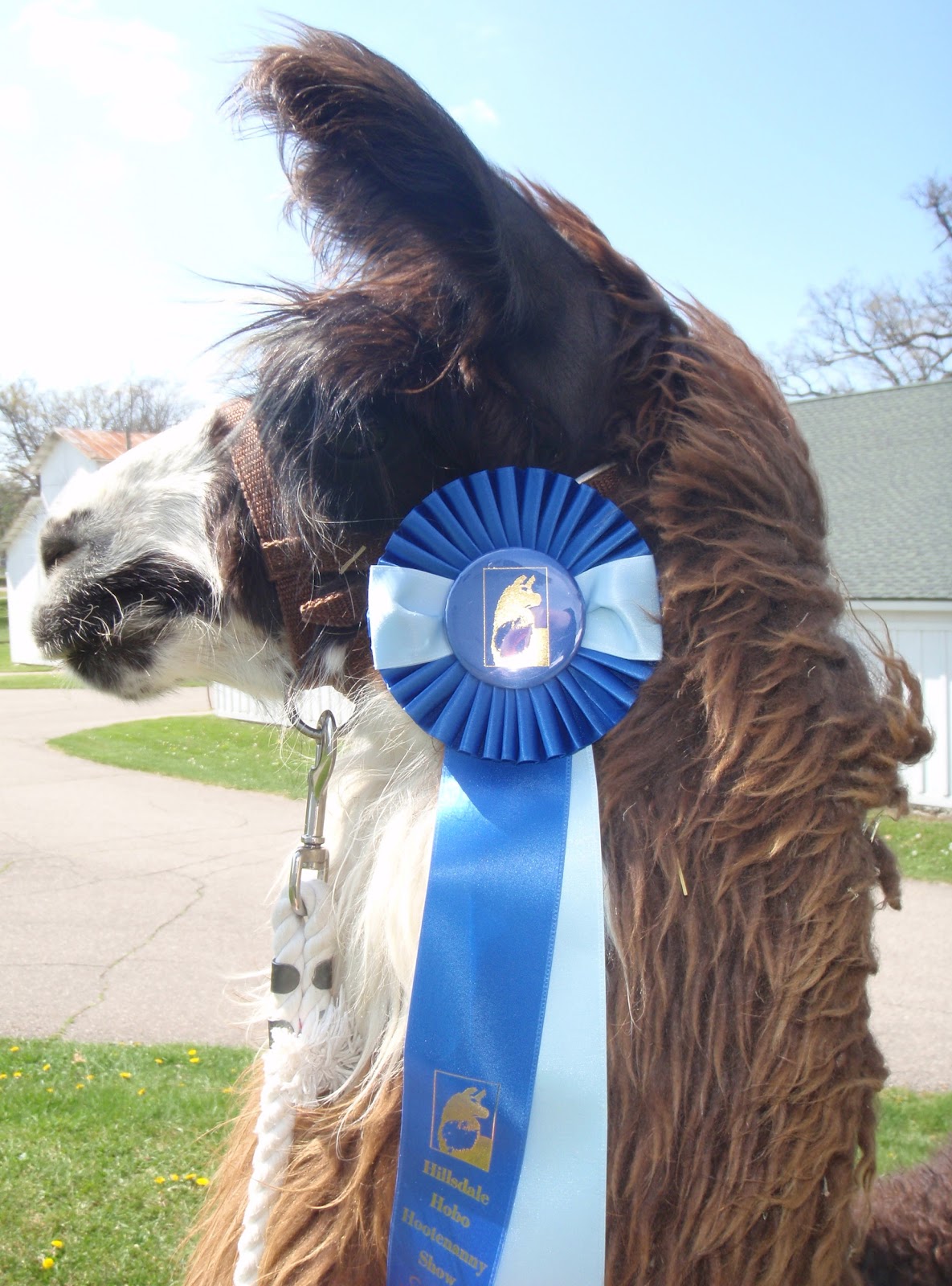
First, results from the Hillsdale Hobo show, our 2012 show season opener!  T and Ralph both did very well for hardly being worked with all winter (my fault, I know!).  T was really freaked out in showmanship for some reason, and I forgot a vital part of the showmanship "pattern" (I forgot to smooth down T's wool after the judge pet him), so we didn't place.  The class was competitive though.  I guess we both need some practice before the state fair!  Halter was awesome though.  T won his class (of 4)- Yearling Non-Breeder.  He didn't get Grand or Reserve, but he didn't behave very well either.  He did compete in Get of Sire for his previous owners though, and they placed second in a very competitive class.  Both boys did great in performance (for them!), doing obstacles I never thought they'd do.  And Ralph finally decided the dreaded stuffed moose wouldn't kill him!  Took 4 years!  Oh, and Ralph got his haircut!

Can you say curls?  I can't wait to shear T!

T modeling his 1st place ribbon!

Such a handsome boy.  I'm really getting attached!

Ralph modeling his new haircut.  His head definitely needs work, and I haven't decided if I should try to trim his legs more or not.  Though after how Bluff's shear job turned out this weekend I probably shouldn't bother!

And next, a puppy update.  Abby has been spoiled the past couple of weeks, and we've gone on some cool hikes.  One up in Lansing, and another in Indianapolis.

The first hike was at an old brick factory!

Hiking down the trail. 
Abby modeling her new Easy Walk harness.  She reacts to it a lot better than the Halti or Gentle Leader head halters, and it works almost as well.

I have a feeling this is an old quarry.

Abby was getting rather pooped!

Turtle!  One jumped into the river just before I took the picture.

The trails follow the Grand River in Grand Ledge, MI.

The second walk was at Fort Benjamin Harrison in Indianapolis.  Kaya (Australian Shepherd) got to join Abby for this one!

My sister and I are planning on taking our two dogs (she has a rescued German Shepherd/Border Collie (?) mix) on a bunch of hikes this summer to get them both socialized.  Abby is definitely over-socialized and needs to calm down around people, while my sister's dog Cerro needs to realize people aren't scary.  Hopefully they can both find a happy medium!

I ended up going home over the weekend, and quickly became knee-deep in llama stuff!  Bluff finally had her cria on the 29th of April, a beautiful little girl my sister delivered and named Autumn Hill's Karakoram (aka Kara).  Apparently Kara's legs were twisted around her head, and my sister calmly figured out the situation and straightened her out.  She's doing great now, and gaining over 1.5 lbs daily thanks to Bluff's amazing milk supply!

Newborn Kara.  She started out at 30 lbs!

Kara at 1 week of age.  Up to 40 lbs already!

Since the cria was delivered and the weather was back in the high 80s, we decided Bluff needed a haircut.  So we carefully groomed her out and gave her a bath Saturday morning, and then started shearing her later that night.  I'm having some clipper problems, so we had to finish up on Sunday.  I knew Bluff would be nervous being in the chute (away from her cria), so we groomed her in the creep feeder with Kara at her side.  We then let Kara loose in the front yard while I washed Bluff, and then they both spent the afternoon in a pen under the barn overhang.  I even sheared 90% of Bluff in the creep feeder, just tied loosely to the fence!  I did eventually have to put her in the chute to finish her belly and legs, but by Sunday Kara nor Bluff were nervous about being separated.  That bodes well for showing them at the state fair in August!

Bluff getting her toenails trimmed before we started grooming.

Gotta love a calm momma llama...Kara was nursing on and off the whole time we were grooming Bluff!  And Bluff was never tied up.

The *before* shot.

The *after* shot- part 1.  She still looks a bit rough here (Saturday night).  She looks better now (I evened her up Sunday), but I still have to finish her back legs.
In fiber news, I finally finished my llama show vest!  It needs buttons and a band in the back to cinch it in a bit, but otherwise I'm very happy with how it turned out.

Hopefully it won't look as frumpy in person!

Close-up of the cable pattern and button band on the front of the vest.  I love the tweedy look of this yarn.
So that's about it for now.  Abby and I are back in Michigan for one last week, then home until late August!  I have lots planned for Kara, T, and Ralph!  And of course tons of state fair projects to work on.  Should be a great summer!

Saturday, July 23, 2011

Beat the heat!

Well I was going to write about obstacles and performance training this week, but considering the massive heatwave that is hitting most of the country, I thought it might be better to write about how to help your animals beat the heat!  These tips are mainly focused on llamas and alpacas, but should work for other livestock and outdoor dogs/cats too!  I'll try to list my tips in order of importance.

Shearing


I wasn't originally going to mention shearing, but now that I think about it shearing is very important.  But personally, every llama (except maybe classics if they are properly groomed) and alpaca needs to be shorn once a year no matter what.  At least the barrel/belly of the lama needs to be shorn.  For my breeding stock, I prefer to do a lion cut (goes about halfway down the back legs) or a full body cut (everything comes off!).  Once you know your animals you will start to tailor how to shear them every year.  I have an old girl who gets cold in the winter but tolerates the heat, so she just gets a barrel cut, even though she is very heavy wooled.  I have another female (light/medium wooled) who hates the heat, so she gets a full body cut every year no matter what.  Crias I will just start with a barrel cut until they are full grown, and all my adults get a barrel or lion cut every year, with a full body cut every 3 years or so.


Fresh Water


Fresh, preferably cool, water is the most important thing that your animals need to get them through a hot day.  Granted, they should have it available every day, no matter what the temperature is.  It's a good habit to dump and rinse out water buckets daily, as animals won't normally drink dirty water!  In the summer, add some ice cubes (or frozen water bottles) to the buckets to keep the water cool, and locate them in a shady spot so they don't heat up as bad.  In the winter, warm water is greatly appreciated.  Electrolytes can also be added to the water- more on that later.

Shade


Being able to get out of the hot sun is key to your animals keeping cool in the summer.  Most livestock have access to barns or shelters of some sort usually, but if this is not possible at least give them some large trees to lay under.  Sometimes the trees are cooler than inside the barn!


Fans


In most parts of the country, fans are also a necessity during the summer.  In Indiana, our fans usually come on in April and don't go off until October!  It makes for a large electric bill, but it can be the difference between life and death for your animals.  You need at least one fan per animal, because the dominant ones won't let the others near their "spot"!  We put most of our fans about hip-high, but also have a couple angled downward from above.  20-24" hanging fans are ideal, but I know many people who use good old box fans in a pinch.  We also have a large (36") high-velocity fan that is amazing!

Hosing


Now onto tips that are more optional, but still useful!  Hosing is one practice that my lamas could not live without during the summer.  They will literally line up outside the barn when they see us turn on the water!  The thing to remember is to only spray the bottom 50% of the animal (legs and the underside of the belly and chest).  The inside of the legs where the hair is short is a good place to hose, it is easier to get the water to the skin quickly.  And don't spray them superficially...try to soak them to the skin.  I've seen too many people "hose off" a llama in 30 seconds...it takes me at least 5 minutes to completely hose one of my animals.  Some animals don't like to be hosed, but most come around with time.

Electrolytes


Over the years, I've himmed and hawed about giving electrolytes.  Sometimes the animals love them, other times they refused to drink them.  They are back to drinking them this summer though, which makes me happy.  I buy a horse electrolyte mix, but a lot of people use powdered Gatorade.  No matter what you use, just follow the directions about how much to mix with a bucket of water (and know how much water your buckets hold!).  Some mixes don't dissolve in water very easily, so shop around if you have that problem.  I realized a couple years ago the added benefit of giving electrolytes to my animals...it can help them drink "funny" water when they are at shows.  A friend of mine had a llama at the state fair who wouldn't drink the city water, so we added some of the electrolytes that I had brought (I had already added them to my llamas' water buckets), and he immediately started drinking.  Two tips regarding electrolytes: Since some animals don't like them, always offer an additional bucket (or more than one) of plain water so they can choose.  Most of the time on my farm the electrolyte bucket gets emptied much quicker than the other buckets though!  And be sure to clean out your electrolyte bucket frequently.  The added sugar makes the water a haven for bacteria, and the bucket can get nasty quick!

Wading Pools


Wading pools are a more controversial topic.  I don't normally like the idea of leaving a wading pool out for most of the year, but when the temperatures get over 90, I don't really care if the animals will use it.  I have heard horror stories about crias drowning in wading pools though, so I don't recommend that you use them if you have young crias or dams about to deliver.  And keep the water fresh!  Prolonged use will rot the fiber too, so be wary if you are letting your show string have access.  My little alpaca Ralph loves water, so I tried giving him a wading pool for the past few years, but he never uses it!  It turns out that my youngest llama Annie has taken a shine to it though.  Supposedly she lays down in it (well, half-way, she's too big so she just puts her front legs and neck in)...I need to get my parents to take a picture!

Concrete/Damp Sand


The last tip is something that I've only heard about, never really tried myself.  Giving your animals access to concrete or damp sand to lay on can help them stay cool.  Unfortunately we have mats in our barn as the concrete is very slippery, so we haven't been able to try it, but I have heard many success stories.

Hopefully this helps give you some ideas on how to keep your animals cool this summer!  This past week has been way too hot...shows all around the midwest are being cancelled (mostly 4-H fairs), and animals are dying.  Be careful in the heat, and be cool!

Monday, May 30, 2011

Shearing time!

Well, better late than never.  Here's the article on shearing that I promised.  It has been published in the Hoosier Hummer, and I may submit it again for the summer edition (or maybe something on showing instead...).  It's getting hot, hope everyone is shearing their llamas!


Shearing Time

            As spring approaches, so does shearing time.  Coats are getting shaggy and summer’s heat is approaching.  Whether for fiber collection, show preparation, or just heat stress prevention, shearing is a necessary part of life with llamas. 
            There are many different types of cuts that can be used on llamas.  The amount of fiber removed can depend on temperature, purpose for shearing, and personal preference. The most common cut for llamas is the barrel cut.  

This just takes off the fiber from between the withers (shoulder) and hips- all the way around the belly of the llama.  A great cut for breeding llamas is the extended barrel cut.  It removes all the fiber from the belly (same as the barrel cut), as well as fiber on top part of the back legs and around the tail.  This is wonderful for nursing mothers because crias can easily find the udder to nurse.  

A modification of this cut can include a strip shorn around the chest.  This allows for a larger amount of air movement under the legs and belly.  

For really warm climates or llamas with very matted fiber, the best cut is the body cut.  This removes all of the fiber on the neck, legs, and belly, but leaves fiber on the tail.  Some people leave a ring of fiber at the top of the neck, and others leave the fiber on the bottom of the legs.  

These cuts can also be combined and changed to fit the needs of each particular llama.  If you have a young llama that you want to keep in full fleece while still cooling it off, you can shear a small strip of fiber from the underside of the belly.             
Several different types of equipment can be used to shear llamas.  The most obvious piece needed is a set of shears- either hand or electric.  Sheep shears are the most common type of hand shears used.  In a pinch, scissors can also be used.  Hand shears are very simple to use, and can produce a good finish with a bit of practice.  They are also a lot less expensive.  

Electric shears are more expensive, but they typically produce a better finish.  Almost any type can be used, from dog and horse clippers to sheep shears, and almost anything in between. 

Other equipment can also be helpful.  A blower of some sort, even a leaf blower, is great to use to get rid of the inevitable dust that accumulates on a llama.  Various types of brushes are also good to remove hay and other vegetable matter in the fleece.
            A quick note about using electric clippers/shears: make sure to read the manual and learn how to correctly care for them.  Learn how to adjust the tension and clean the blades.  The most important thing is to always keep the blades oiled- most brands recommend doing this every 1-5 minutes.  It also helps to completely remove and clean the blades between llamas.
        A couple things must be done before shearing can begin.  All llamas should be blown out and brushed, if only to prolong the life of the shears or blades.  If you want to harvest the fiber for later use, there are other steps that can also be done.  

It helps to wash the llama after it is brushed out, to completely remove dust and debris.  Just make sure to allow the fiber to completely dry before shearing- it works well to wash on a warm and slightly windy day.  When washing a llama, think ahead about a place for them to dry.  If the llama is used to being on a stake-out line, that works well.  However, young or inexperienced llamas should be allowed to dry in a pen or clean pasture.  I’ve seen too many llamas get their leg wrapped in the stake-out line, so I always use a small pen for drying.  Don’t just put a wet llama back in the pasture- there are too many dust bowls and other things to make them dirty!  There are many different types of shampoos that work well with llamas.  I’ve had success with all types of shampoo and conditioner, from llama and dog to horse and human!  The most important point is to make sure to completely rinse the shampoo out of the fiber- spend more time rinsing than you think you need to.  Conditioner can also be used, but beware of a residue or scent that could stay on the fiber.  Again, just make sure to completely rinse it out.  If you are short on time, just groom out and wash the barrel of the llama- after all, that is all you will be shearing.

            Another important thing to think about is where you will be shearing your llama(s).  Very well behaved and well trained llamas can be shorn in a small pen while unhaltered.  Others may need the use of a chute.  It is also very easy to shear a llama that is haltered and tied to a fence or post.  A distraction for the llama, in the form of food, helps immensely.  Have a helper feed the llama while you shear, or work someplace where a bowl of food can be easily placed in front of the llama.  For very unruly animals, there are several herbal and over-the-counter calming aids that can work miracles.  Just make sure that the llama is safe where ever it is to be shorn.
            Now that the llama is clean (and dry), it is time to start shearing.  I like to start along the topline.  Use a brush to part the llama’s fiber, and then start shearing. 

I find it easier to start at the top and work down towards the bottom of the belly.  Keep in mind where you want your cut to end, and stay a few inches away from those imaginary lines.  When most of the fiber has been removed, go back and cut along the edges (around the shoulders and hips).  

Even if you don’t plan on using the fiber that is shorn, it is easier to collect it all as you go, instead of letting it accumulate on the floor.  Garbage bags, paper grocery bags, and even feed bags work- just open one up and set it next to where you stand.  Shear with one hand and grab the fiber with the other, depositing it in the bag as you go. 
            If you plan on using the fiber, there are several helpful tips to keep in mind.  The most obvious one is to make sure that the llama is really clean before shearing.  It is much easier to clean the fiber while it is still on the llama.  Definitely make sure to have bags of some kind to collect the fiber in.  Paper grocery bags work well- they are clean and only take 1-3 per llama.  Another important thing to remember is to try to avoid second cuts of fiber.  These little bits of fiber produce knots and bumps in yarn when spun.  I prefer to shear the llama first with hand shears, as it is easier to see where you are cutting and avoid producing second cuts.  Once the bulk of the fiber is off, go back with electrics or the hand shears again and smooth out the fiber.  There is really no use for second cuts- just put them in a SEPARATE bag and throw them away. 
            Congratulations, you now have a shorn llama.  This is a great time to take new pictures- everyone is clean and freshly shorn!