Showing posts with label Duque. Show all posts

Thursday, July 3, 2014

Llamas: the "Green" Lawn Mowers!

I don't really consider myself lazy, but I guess in some respects I am.  Or maybe I'm smart!

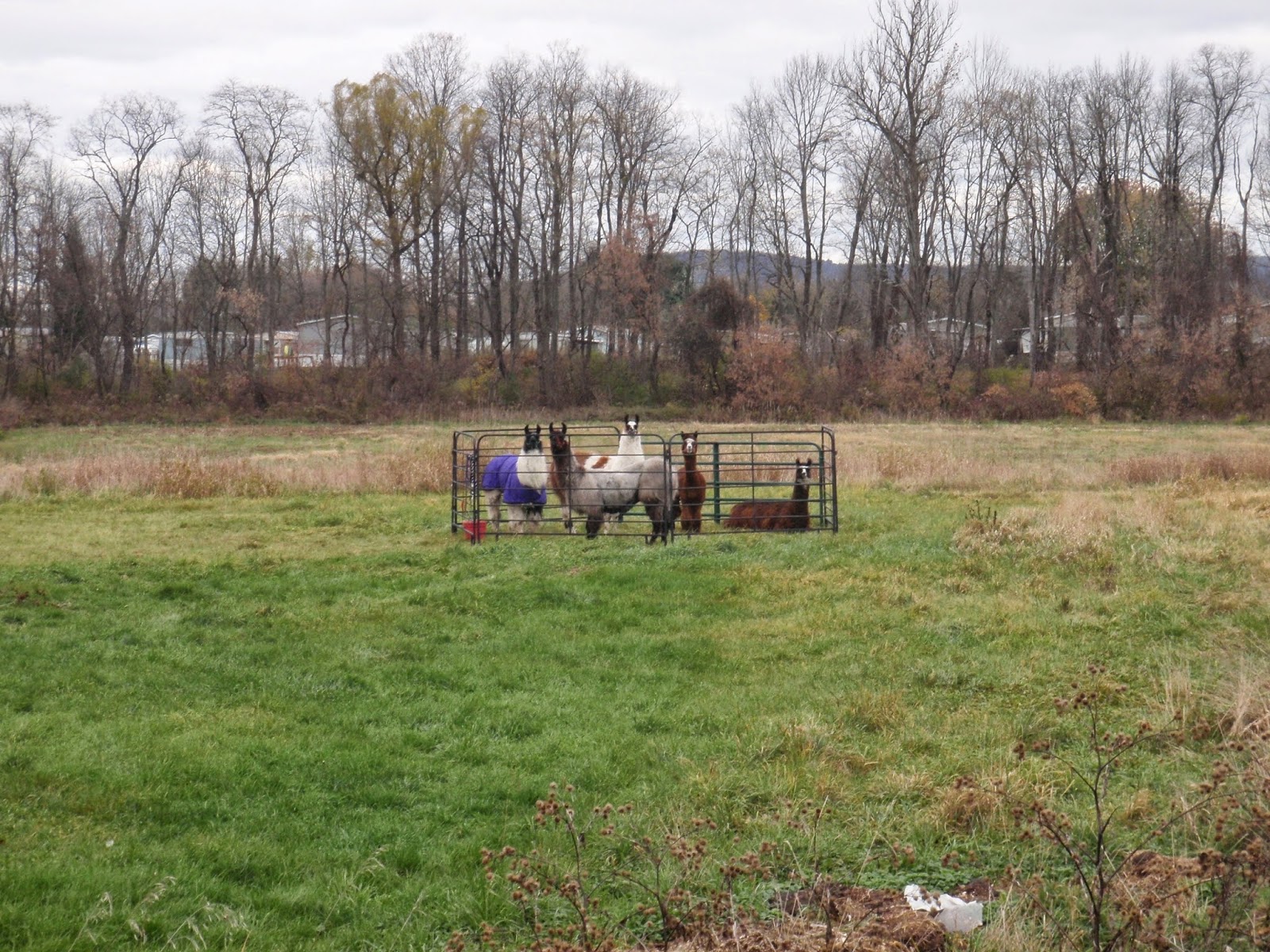
Last year when the lamas grazed their pasture too low, I started letting them graze in other areas, inside a pen made from stall panels.  It was a lot of work to move the panels and walk the lamas out there every day, but they really enjoyed being able to graze.

The gang grazing late last fall.  I'm a firm believer in grazing for as long as possible!

Early this spring I continued the practice, before I would let the lamas back on their own pasture.  I moved them to a different spot though...around my garden!  We'd been having problems with groundhogs, so I wanted to keep the grass low around the garden fence.  Originally I set up the pen on the outside of the garden, but occasionally I moved it to the inside.

The gang in their pen next to the garden fence (on the outside).

Duque and T in their pen on the inside of the fence.

Over time I've begun to realize that it is fairly easy to bush-hog the grass on the outside of the fence, but the inside is much more difficult.  The ground is so uneven that it has to be mown with the push mower (it is also too narrow for the tractor in some spots), which is a lot of work!  Last week I set up the pen on one side of the garden (on the inside), so that the lamas could eat some of the really tall grass.  It has been too hot recently to let them out there, but tomorrow they're going back!  Hopefully they can graze during the day this weekend too.

Kara and T grazing inside the garden fence (within a pen too).

Before we moved to a place that had 2 unruly dogs, we used to stake the llamas out in the front yard to graze.  It is great training, and less to mow!

Duque staked in the front yard back in Indiana.  It is also a great way to dry llamas after washing, but without them getting dirty!

I did start stake training T and Kara this spring, but within the confines of the garden.  If a llama hasn't been stake trained before, you can't simply tie them out and leave them, they must be supervised.  T did really well, and Kara only twisted herself once!  Unfortunately it isn't safe to let them graze on a stake outside of the garden here, too many stupid dogs!

T and Kara grazing while staked in the garden.

Thursday, May 22, 2014

Shearing is DONE!!

Finally, after 2 long weeks, shearing is done for the year!  I have a love-hate relationship with shearing...I hate doing all the grooming and I'm terrible at shearing, but I love having fresh fiber and I love how the animals look shorn!

First up was Ralph.  I'm not brave enough to shear him on my own (and my shears are definitely not up to the challenge), so I got a recommendation for a local shearer and called them up.  I didn't want to pay a set-up fee for just Ralph, so I took him down to their farm while they were shearing their own animals.  It has been several years since Ralph was shorn while stretched on the ground (he's been shorn standing at a llama show we used to go to), and he was NOT happy!  Luckily he didn't pee himself this time though!


And now I have 1 handsome burr-less alpaca, and 2 gorgeous bags of fiber!  The best fiber is at the mill, ready to be processed into roving.  The leg and neck fiber will go to another mill in a few weeks, to get made into more insoles.

Ralph's fiber will get processed the same as last summer...it will look like this!  70% alpaca, 20% merino, 10% firestar.

Next up, and first for me, was April.  April's always the easiest for me...she has pretty terrible fiber, so I don't bother grooming her like I do the others.  I just blow the dust out (to save my shears), and go for it.  She always ends up with the best haircut too, since her fiber is so coarse and easy to cut with the shears.


First for a "real" grooming was Duque.  Luckily he was pretty clean, so just a bit of brushing and a bath and then his haircut.  He even got to spend the afternoon grazing in the garden with T while he dried.  Duque's fiber is going to be hoarded this year for a special project...details to come.

Duque and T in their garden pen.

Duque getting shorn.

Handsome boy!

T was next to get shorn.  He took a TON of brushing, and I didn't realize how dense his fiber was!  A couple hours later he was ready to blow out and wash.  He had to stay out overnight with Duque and Kara to dry.  He was not real happy about being shorn, but finally with a bit of a bribe we got it done. He got a complete body shear, and unfortunately I had to toss most of his neck and leg fiber since it was so full of burrs.  He looks a bit rough right now, but hopefully by the time the NY State Fair comes around in August he'll be grown out and look decent.  T's fleece has already been sold.


Last but not least was Kara.  She wasn't quite as dirty as T, but I'm planning to show her fleece this summer and fall, so she had to be impeccably clean.  Luckily she doesn't mind being groomed as much as T!  She also had to sit out for a couple days to dry since her fiber was so dense.  I decided to hand-shear her first so I could get the fleece without any second cuts, and for some reason she freaked out!  Once I started cleaning her up with the electric shears she was fine.  Weird girl!  I really hope her fleece does well at the shows!

Kara didn't want to stand up straight!

My gorgeous little herd of shorn lamas!  Pardon T's stance.

Thursday, April 10, 2014

Llama Birthdays!

My mom thinks it is silly that I concern myself with remembering the birthdays of all our llamas (at least the ones we currently own), but I think it is important to remember their important milestones!

April is the big one this year...on Tuesday she turned 20 years old!!  They say that the average lifespan of a llama is 20-25 years, but the more I talk to breeders it seems not uncommon to lose a llama due to old age at 15-16 years old.  So, 20 is pretty old for a llama!

April was part of the second batch of llamas that we bought in the spring of 2000.  You can read her full biography here.

Baby April, back in 1994.

April in her prime, spring 2003.

April's crowning achievement...winning 1st in Heavy Wool Adult Female and 3rd overall Heavy Wool Female at the 2002 Great Lakes Regionals!

April as she looks now...this was spring 2013.  She hasn't changed much!

Duque's birthday is tomorrow...he will be 17!

Duque was part of the very first group of llamas we purchased in the fall of 1999.  You can read his full biography here.

Baby Duque with his mom, 1997.

Duque in his prime, spring 2003.

Duque's biggest achievement, Reserve Grand Champion Non-Breeder at the Great Lakes Regionals.

Duque as he looks now...this was spring 2013.  He is so grey!

Kara's birthday is at the end of the month...she'll be 2!

Tuesday, April 8, 2014

Fiber Forecast

While carding away at work today (I work at a local fiber mill, if I haven't mentioned that before...), I realized that I'm barely going to have any of my own fiber to work with this year!

I may be the only person who plans ahead this much, but I look forward to shearing so much each year that I fantasize about what I'm going to do with each fleece while I'm waiting.  Silly, maybe, but it helps pass the time!

Last week a woman from a nearby farm pre-ordered Kara and T's raw fleeces.  I was planning on having them blended together into roving, maybe with some bamboo, but I'm excited to see what she does with them instead!

T has a bit less fiber this year (he was body shorn last spring), but it is still the best on the farm!

I will still be showing Kara's fleece this year.  I need to decide how many shows I can afford to send it to...

I really need a more recent body shot of Kara!

April's fleece is too coarse for roving, so hers will be made into insoles with the rest of the neck/belly/leg fiber that I shear off the boys.

April has many great qualities, but fine fiber isn't one of them!  Luckily her crias had it!

The felted insoles I had made last year.

Duque's fleece is going to be made into a special project this year.  I'm going to wash, card, and spin it myself, and then knit a lace piece.  Details to come, I can't give too much away!

Good old Duque!  It is hard to believe that he was born almost coal black!

And last but not least is Ralph.  His fleece is the only one I will have available to get processed into roving!  Last year it was processed into a beautiful roving, with 20% brown merino wool and 10% red multi firestar.  It sold out pretty quick, so I might just have to repeat the blend!

Ralph with his terrible haircut.  Hopefully we'll get his legs trimmed better this year.


Ralph's roving blend from last summer.

Of course you could always purchase his fleece for yourself...it is available as part of our fiber CSA!

And in other news...today is April's birthday!  She turns 20 years old, which is quite a feat!

Baby April!

Thursday, March 13, 2014

Locked Up Lamas

I really felt like a broken record this winter...it seemed like every other Facebook post was something along the lines of "locking the lamas in again tonight".

Locking the lamas inside the barn at night was not something I had really ever considered doing on a regular basis.  The one exception was when we had a baby born...we would routinely shut the new mom and baby in our catch pen/creep feeder (basically just an extra 8'x12' pen in our barn) for a night or two to bond and stay out of the cold.

May and her cria Camissia, locked in the catch pen for the night.

And then we moved to NY and had the winter from he**!  It dropped below 0 degrees more times this winter than I could count, and we often had wind chills in the double negative digits!  My Midwest lamas were definitely not use to this, and they were suffering.

April laying in one of her favorite spots, out by the hay feeder.

My preferred first treatment for the cold is insulated coats.  The only lamas that I saw shivering this winter were April, Duque, and Ralph.  They all wore coats through at least half of the winter; Duque and Ralph wore theirs a bit less than April.

Duque and Ralph in their coats.  Duque has since inherited April's coat, since April got a new thicker one!

It got so cold at times though that I would see April and Duque shivering, even with their coats on!  That's when I knew I had to do more to keep them warm.

Luckily the lamas' pen is on the south side of the barn, so the wind is normally not bad.  But in the cold winter, even a heavy breeze can drop the wind chill severely.  Since April apparently doesn't like being in the barn, the only way to keep her out of the wind was to lock her (and everyone else) inside the barn.

As I've mentioned before, I put down a lot of waste hay in the barn this winter for added insulation agains the cold.  So in addition to being out of the wind, they have the benefit of laying in a nice warm bed and not the cold concrete or frozen ground outside!

Nice bed of waste hay in the barn.

My threshold for locking the entire herd inside was whenever the temperatures were below 0 (Fahrenheit), or if the windchill was in the double negative digits.  There were a couple exceptions, mostly when it was warm and rainy and then supposed to get really cold quickly.  A few times I just locked April inside (in the catch pen) with a friend (usually Kara or Ralph).

April in the catch pen (eating her dinner).

Of course April hates being locked in the barn, but it has definitely helped keep her warm this winter.

During one extreme cold spell, the lamas stayed in the barn for 2 days and 3 nights (in a row)!

I even locked them in last night, even though the temperature was just under freezing.  They had been standing out in the rain all day, and the temperature was supposed to drop to almost 0 degrees during the night.  I went back outside this morning to feed, and found 5 happy, warm, and dry lamas, even though it was still in the single digits outside!  I put coats on the 3 regulars, and gave them their freedom.  Now that they're dry they'll be fine outside tonight.

And now for a little cheering up...SPRING!

Sunday, March 2, 2014

Skin Issues Revisited

About a year and a half ago, I wrote a blog post about some skin issues that 2 of my llamas were having.  I'm having issues again (1 of the same llamas, 1 different one), so I thought I would share what I learned from the first time and what I'm trying now.

In 2012, I was having trouble with Bluff and April.  Bluff had a bit of "elephant skin" (basically thick skin) under her front armpits.  I decided to treat her with a cream made from diaper cream (zinc oxide), vitamin E, and tea tree oil.  Unfortunately it didn't seem to make any difference, so I discontinued the treatment.


April had developed some bald spots on her legs.  The skin wasn't thick and crusty like Bluff's, just had no hair!  Since there was no chance of rubbing a cream on April's back legs every few days, I decided to make up a sprayable mixture of MTG (a horse skin product), vegetable oil (to soften the skin), vitamin E, and tea tree oil.  It turned out that the vegetable oil was a bad idea for summer, since it attracted flies.  The MTG is also too thick for a spray bottle, so I wasn't able to continue the treatment for very long.  Needless to say it didn't work.

Since I wasn't living on the farm for most of the past several years, I didn't have another opportunity to address April's skin issues until they moved to my new NY farm in August.  After talking to some breeders on Facebook, I decided to try spraying her legs (and Duque's) with apple cider vinegar.  I was actually good about applying this treatment (it was easy!), but after about 6 weeks I still saw no improvement so I quit.  I'm giving up on April's feet until it warms up in the spring, but am thinking about trying a new horse product (one that is designed to be sprayed) or diluted betadine.

Duque's back feet started off like April's, just looking like simple hair loss.  However, over the past month or two I noticed more dry scaly skin so I decided to start treating him again.  Luckily Duque is easier to handle than April, so I tried the skin cream I made for Bluff a second time.  I applied it every other day for 2 weeks, and saw no improvement.  The cream was applied to one back leg, and on the other I applied MTG.  The MTG didn't work either.  After more consulting, someone suggested that he may have mites and should be treated with Frontline spray.  Frontline is almost $50 at TSC, so when someone else suggested Vaseline instead I decided to try that.  I started the second treatment today, and will be applying it twice a week for 3 weeks.


Kara also has something similar to Bluff, rough spots on her front armpits and her chest.  I'm also trying Vaseline for her.

If the Vaseline doesn't do the trick in a month or so, I suppose I'll try another of the many products that are available.  NuStock is widely recommended, as is a product called Well Horse.  I'll try to report back in a month with progress!

Saturday, January 4, 2014

Caring for the Elderly Llama (or Alpaca)

I'd been struggling the past week or so with what I should write about for my next blog post.  Then as I was outside this morning feeding April, I got my inspiration!  I've already written a post about cold-weather care, but nothing about caring for an older llama or alpaca.

Duque!

At the 2013 GALA Conference back in November, one of the vets mentioned that she likes to start "senior" care for lamas when they hit about 10 years old.  The average lifespan of a lama is 15-25 years, so that makes sense.  I've been doing "senior care" for two of my llamas for the past 8 years or so.  April is going to be 20 in the spring, and Duque will be 17.  I will give a disclaimer that caring for senior lamas can be very time consuming and expensive, but for me it is worth it!

I'm going to break the topic down into a few categories, to make it easier to follow...

Arthritis

Arthritis (or other physical/conformational issues) is fairly common in older lamas.  Just like humans, they get to the point where they are stiffer in the cold, and they are slower to get up and walk around. Dropped pasterns are also a big issue, especially for geldings (neutered males) or overweight animals.    (The lower amounts of testosterone in gelded males is thought to contribute to the breakdown of the pastern tendons.)  Unfortunately neither dropped pasterns nor arthritis can be treated, but they can be managed.

Duque's dropped front pasterns.

For dropped pasterns (and other tendon issues), there are a number of supplements that can be given.  There is an herbal supplement designed for llamas that is supposed to somewhat reverse the effects of dropped pasterns, but it didn't really work for Duque.  Plus it is a fine powder, which was impossible to get him to eat!  In regards to supplements, I have started using those formulated for horses, and giving 1/3-1/2 of the horse dose for a llama (roughly 300-350 lbs).  There are several tendon supplements for horses as well, and some come in pelleted form.

For arthritis, the common supplements are glucosamine and chondroitin (also commonly taken by humans and given to dogs).  There are also lots of joint supplements available for horses, as well as an arthritis supplement for llamas.  In severe cases, injections of glucosamine/chondroitin can be given, as well as pain meds (banamine or bute).

Duque has had dropped pasterns for several years.  He comes from a bloodline where this is common,  is a gelding (has lower testosterone than intact males), and has been overweight for most of his life.  His pasterns started dropping when he was only 5-6 years old, and thus had to be retired early from the show ring.  Now that he is almost 17 years old, he doesn't like to stand for long periods of time and he walks rather slow.  There are days that I really worry about him, but the next day he will run around the pasture with the young animals so I have to make myself stop worrying!  Duque has been on glucosamine and chondroitin supplements for horses for years.  I currently have him on a 1/2 dose of SmartFlex III Resilience Pellets.  It is hard for me to tell whether or not they are working, but I'm afraid to take him off them completely so I'm just going to keep feeding them!  The nice thing about the pellets is that they are very easy to get him to eat.

Miraculously, at the ripe old age of 20, April has still yet to show any signs of arthritis.  I'm amazed, and will consider to count my blessings in this regard!

Obesity/Overweight

It may sound a bit counter-intuitive, but obesity can be a big issue in older llamas.  They don't move around as much, they tend to get babied more (aka extra/better feed!), and the weight just packs on.  Being overweight can be just as detrimental to their health as being underweight, and it is a lot harder to fix!

The best way to get weight off a lama is exercise!  Take them for hikes if you can (gradually building up time and distance), or put them in a big pasture.  One great tip I heard was to put their hay and water at the opposite end of the pasture as the shelter, so that they had to walk back and forth frequently.

Duque going for a hike!


If exercise isn't a viable option (such as an old llama with bad pasterns or arthritis), you will have to cut their feed.  A normal lama needs 2-3% of its body weight in roughage (grass/hay) daily, but if you have an overweight animal they can survive on 1-1.5%.  Personally I think the key is to reduce both the amount and the quality of the hay they are given.  I prefer to give 1.5-2% of their body weight in a first cut, stemmy hay (with low protein- under 10%).  Eliminate grain, just offer free choice minerals and fresh water.  Make them clean up all their hay before you feed more.  Obviously this is a lot easier to do in the winter when they aren't on pasture, but it can also be done during warm weather.  You can dry-lot the obese animal (put on a pasture with little to no grass), or lock them in a stall and only give them a few hours outside to graze.  It may sound mean, but getting the weight off is imperative to their health!

Duque (and several of my younger llamas) has battled obesity for most of his life.  My mom really liked to feed the lamas grain every day, whether they needed it or not.  At his worst, Duque got up to about 400lbs.  After moving to the new farm in August, he has since lost about 20 pounds by limiting his grazing and feeding low-protein hay.  Now at a slim 330 lbs, he is where he should be!  I'm back to feeding him a bit of grain every day so that he doesn't lose more weight.

Duque during his "fat" years.

Underweight

After having April on my farm for almost 14 years now, I feel like I'm an expert when it comes to feeding underweight lamas!  April has always been really thin (I think she just has a really quick metabolism), and it has been a challenge to keep her at a good weight, especially now that she is quite old.

The only way to put weight on a thin lama is feed, feed, FEED!  And you also need to look at how you are feeding: a lot of thin lamas are at the bottom of the pecking order within the herd, so they are often the last to eat.  It is imperative to separate any thin lama while they eat, so that they aren't bullied.

April eating in her pen.

There are a ton of different feeds that you can give a thin lama to encourage weight gain.  The foundation of your feeding program for an underweight animal is a high quality hay, preferably with a bit of alfalfa.  I would aim for something with at least 14% protein if you can.  Feed this high quality hay free-choice, so that they can eat as much as they wish.  The second most important feed to give is a good llama/alpaca supplement (also referred to as grain or pellets).  Again you want something with high protein.  Follow the feeding guidelines for the supplement, but you could feed an extra 0.5-1.5lbs of the supplement daily.

Next comes the long list of add-ins...  My favorite is Calf-Manna, a high protein supplement designed for a variety of livestock.  Our old vet said we could safely feed 2lbs of Calf-Manna daily without having to worry about copper toxicity.  April has been on at least 1lb daily for the past 10 or so years, and she seems just fine!  Something new that my new vet recommended was rice or wheat bran.  It is high in protein and fat.  It comes in many forms, commonly oil and pellets.  I chose to give April the pellets (manufactured by Manna Pro), since I didn't think she would eat the oil.  I'm giving her 1/3 of the horse dose.  After doing a bit more research this fall, I decided to start April on alfalfa pellets and beet pulp.  Both are supposed to be great for weight gain.  Due to a recent choking episode, I chose to soak the pellet mixture in water to re-hydrate them before feeding.  It took a few days, but she eventually learned to eat them.  And now that it is cold I soak them in boiling water to make a warm mash.  It is hard to measure the pellets since they expand after soaking, but I figure she gets about 1/2lb of a 50:50 mix daily.  I also recently decided to try adding a little bit of oil to the mash mixture...I had recommendations for corn, soybean, and canola oil.  I've read that you can feed up to 1/4c daily, but work up to that amount slowly.  April got 1T today (day 1 of adding it in).

Alfalfa pellet/beet pulp mix, before re-hydrating.

There are still more things that you can feed underweight lamas!  Some people swear by corn or oats, but I don't like that they appear to pass undigested.  I've heard recommendations for Equine Senior (a horse feed), but it has much higher copper than Calf-Manna.  I've also heard a lot about Chaffaye (sp?), which I believe is shredded hay with molasses.  I just can't find any local!

Cold/Heat

A lot of older lamas have issues with the cold and heat.  Luckily my 2 do fine in the heat, but they both get very cold in the winter.  Now they both have insulated coats to wear, and I put them on at the first sign of shivering.  April will end up wearing hers most of the winter, while Duque can tolerate a bit more cold.

April in her awesome coat!

When it comes to heat intolerance, there are a few simple tricks to keep them cool.  Shearing is a must, as is fresh cold water.  Fans and shade are also important.  If it gets really hot I like to hose their bellies off to cool them down.

There are also a few tricks for cold intolerance.  Lots of good food (hay generates more body heat as it digests than pellet/grain supplements), shelter from the wind, deep hay/straw bedding to lay on, fresh warm water, and blanketing if necessary are just a few suggestions.  For more in-depth explanations, see my previous post.

Duque in his less than awesome coat (but it still keeps him warmer than without it!).

Teeth

Just like horses (and any animal really), a lama's teeth can decline rapidly with old age, and us owners usually have no idea!  I only recently discovered that April has no front teeth, so I can only imagine what her molars look like!  I've definitely started to realize the importance of having a vet (or doing it yourself, if your lama will allow it!) check out the lama's teeth every year or so.  Uneven chewing can cause sharp points, which can be easily filed down.  Weight loss in older lamas is often caused by bad teeth.  If you've ever seen small piles of half-chewed hay around your feeders, you most definitely have an animal with teeth issues.  The front teeth can also get too long, interfering with grazing.

Duque and his long teeth.  Luckily they aren't quite long enough to warrant trimming.

Parasites

Older animals are more susceptible to parasite infections than younger animals, and it will usually take them longer to recover after treatment.  I would pay special attention to doing regular fecals on older lamas, and would probably treat if they had a lower level than a young adult did.  I'm also starting to think that regular probiotic supplementation would be a good idea, to support the good bacteria in the gut.

View through the microscope of a fecal exam.  In the center (grey spot) is a nematodirus egg.

Conclusions

As I mentioned before, feeding and caring for an older lama is neither cheap nor easy.  I spend longer waiting for April to eat her food (in a separate pen) than it takes me to clean the entire barn and pasture each day.  I spend more on Duque's tendon/arthritis meds and 5 different types of feed for April than I do buying hay and grain for the entire group of 5 lamas!  But they have given me a lot of pleasure and joy over the years, so I feel like it is the least I can do for them.  I am realistic though, and if either one gets to the point where they are suffering, I will do the humane thing and let them go.  As much as I hate to think about it, Duque will certainly go lame in the next few years, so I know that hard decision is waiting for me.  Luckily I think April will be around for a good long while!

April!