Sunday, April 15, 2012

Crias!

No, no cria from Bluff yet, but all this waiting gave me the idea to write about what to expect when a cria is born and what supplies to have on hand.

Ralph saying hello to Cattera's newborn cria, Catallegre.

Hands down, crias are my favorite part of raising llamas!  There's nothing cuter than a fuzzy little baby llama!  And after waiting ~11.5 months, their birth tends to be a big deal on most farms.

Catastrophie standing proud over her newborn cria, Annapurna.

Llamas are very stoic animals, and this applies to birthing as well.  With most females, you will have no idea when they are going to deliver.  I like to watch udders, but you have to know your particular female(s).  I have had some females who won't produce milk until the day they deliver, while others (including Bluff) will have a full udder for a month or two before they are due.  When I had multiple females due every year I would keep a record of when they started to develop an udder, and then use that information the next year to try and determine when they would actually deliver.  Some alpaca breeders swear by checking the ligaments around the tail- they should soften the day of delivery.  Another possible sign is a relaxed vulva- it will look a lot bigger and even show the pink lining when birth is imminent.  Some females will go off by themselves to deliver.  I had one female who wouldn't ever deliver when someone was home!

This can be a bad sign- lying on their side with the back legs thrown out to the side.  This is Bluff (pregnant with her first cria), who was experiencing a uterine torsion.

This is a normal sign: a relaxed vulva.

When birth is really near, most females will get up and lie down repeatedly.  They'll visit the potty pile a lot, but won't actually go to the bathroom.  Sometimes they will shift from side to side when they are lying down.  You may actually see the water break, or you may just see the nose and toes appear!  If everything is going right, you want to see the head and two front legs first.  If you have anything other than the head and both front legs, CALL YOUR VET!  Delivery tends to stall at this point for a few minutes, don't be worried if the cria just dangles there.  It's good so that the fluid can drain out of the cria's nasal passages.  If there is any membrane around the cria's nose or mouth, go ahead and remove that.  It normally won't take more than 15-30 minutes for the shoulders and the rest of the cria to be delivered- if it is much more than that, you might want to call the vet or assist the dam yourself.

Once the cria is delivered, stand back and let mom and baby bond for a few minutes.  The cria will thrash around a bit in an attempt to kush upright or even stand.  As long as the cria is breathing and moving around, you don't have anything to worry about immediately.  After a few minutes (or right away if it is particularly wet or cold), try to sneak in and dry off the cria.  Some dams will freak out if you try to mess with their crias, while others have no problem.  Just be cautious and watch your particular female.  Pretty soon the cria will try to stand.  You'll want to dip or spray the navel with 7% iodine or novalsan right away, and at least a few more times that day and the next.  If the umbilical cord is particularly long, you may want to tie it up so that it doesn't get stepped on or ripped.  It should fall off in a few days.

Cattera and her newborn cria, Cataleya.

Now that the cria is standing, it will start looking around for the milk bar.  Most crias will try to nurse every possible spot on the dam before they find the right spot.  I tend to let the cria explore on their own for 15-30 minutes, but if they still haven't latched on by that point I will steer them in the right direction.  Again, hopefully the dam will let you assist.  Crias nurse a bit differently than most people would expect- they switch between nipples rather quickly (I believe it is something like every 3 seconds they will switch), and don't nurse for very long at a time (normally no longer than a minute or two).  You can check the cria's lips for milk residue to tell if they have been nursing successfully.  The cria needs to nurse in the first 6 hours to get the beneficial colostrum.

May allowing her cria, Camissia, to nurse.  Notice how May's tail is wrapped- we like to do this a week or two before the female is due, as it helps keep them clean during delivery and makes it easier for us to see what is going on back there.  Camissia's ears are also taped- they were very floppy at birth.

After the cria has nursed, you can do a bit more hands-on examination.  Make sure the teeth have erupted (no teeth is a sign of prematurity), and you can stick your little finger in their mouth to check for a good suck reflex (a weak suck reflex can cause nursing problems).  Droopy ears or weak pasterns are other signs of prematurity.  You may want to take the cria's temperature- normal is 100-101F.  You'll definitely want to weigh the cria at some point.  Normal birth weight can range from 20-35lbs.  The important thing is to weigh the cria at the same time every day for at least a week- the cria should gain between 0.5-2lbs a day.  Any weight loss or stalling of weight gain should be talked over with a vet.

A perfect example of droopy ears.  All of May's crias were born with ears like this (actually May herself was too!), I believe it was partly genetic, partly because they all were somewhat premature.  We routinely would tape up droopy ears to help them hold shape.

Within 1-6 hours, the dam should deliver the placenta or afterbirth.  If this doesn't occur within 24 hours or the placenta doesn't look to be in one piece, CALL THE VET!  Whatever you do, don't pull on the placenta!  We learned this the hard way!  Some dams are really uncomfortable until the placenta passes, and won't let the cria nurse until then.  As long as it doesn't take more than 5-6 hours, don't worry too much.

Catastrophie with her first cria, McKinley.  Alpacas Alejandro and Moreo look curiously at the new addition.

Depending on the weather, time of day, and your female, you can put the mom and baby in a stall, or leave them in the pasture to continue bonding.  If its raining, cold, or almost dark, we'll normally go ahead and bring them in the barn.  Otherwise just leave them outside.  If you have any pushy individuals in your herd, you might want to put them in the barn or a different pasture.  We like to keep the mom and baby in the barn at night for the first few nights (less if the weather is nice, normally at least 2 nights).  We bed a stall down with straw, and add water and hay for the dam (plus some grain).  Make sure there isn't anything the cria can get into.  If the weather is cold but dry, you can use a cria coat (or a child's vest) to keep the cria warm.

Catastrophie and her second cria, Annapurna.  Annie was born in late September, and wore a coat on and off her first winter.

Some people like to give an enema to the cria within a few hours of birth, to help them pass the meconium (first feces).  We don't do this anymore, unless the cria doesn't pass the meconium within 24 hours or appears weak or lethargic or is straining.

A very tired Catallegre laying in the pasture with his mom, Cattera.  Being born is a lot of work!

You'll want to continue dipping the navel for another day, monitor nursing, and weigh the cria daily for at least a week.  Make sure the cria pees and poops (it is not uncommon for the cria to have a thick, yellow feces for awhile, especially if the dam is a heavy milker- however, if this turns into persistent diarrhea, call the vet).

Bluff letting her first cria, Rainier, nurse.  Bluff is an extremely heavy milker, and both of her crias experienced "mustard poop" on and off for their first few weeks of life.

Now all that's left is to sit back and enjoy your healthy cria!  I'll try to post stories of some of our llama births over the years.  No birth is ever the same!  I apologize for not having birthing sequence photos to show, but they are all in hard copy and I don't have a scanner!  There are tons of great websites with photos though!

April keeping watch over the fall 2005 crop of crias (L-R: Trillium, Catastrophie, Inali).

Oh, and our list of cria supplies:
             Powdered colostrum
             20 oz. plastic pop bottle (washed out)

 Red Pritchard nipples
 Baby bottles and nipples
 Enema
 KY jelly
 Thermometer
 Bulb aspirator
 Novalsan/iodine
 Film canisters w/ lids (washed out)
 Cotton gauze pads
 Clean towels
 Digital scale & sling
 Cria coat
 NurseMate (colostrum paste)
 Electrolytes
 Cria books

One of my favorite photos...3 generations!  The brown cria is McKinley, his mom is the appy (Catastrophie), and Taz's mom is the brown/silver girl sniffing the cria (Cattera).

Sunday, April 8, 2012

Happy Birthday April! (And other updates!!)

First and foremost I must with my beautiful llama, April, a happy 18th birthday!  It's hard to believe she's that old, she's in amazing shape.  If I didn't have 2 little geldings to show I would definitely be taking her back into the show ring this summer!

April and I in 2002 at the Great Lakes Regionals.  She placed 1st in Heavy Wool Adult Female & Top 3 Heavy Wool Female!  

Next, an Abby update.  She's recovering nicely from her spay, today was her first day of freedom!  She built up a lot of energy not being able to walk or play for 10 days, but she's finally tired out tonight...it took a lot of work!

Sound asleep...upside down!  I have a weird dog...

Fell asleep mid-chew.  Notice her cool new collar...its a topo map!

This is an older (pre-spay) pic...but too adorable not to share!  Hank is sleeping on Abby!

It takes quite a lot to make Abby cock her head these days!  She was very amused with the sound of my desk drawer closing.

And the quintessential "guilty dog" look...or rather she's trying to make me feel guilty for not playing with her!

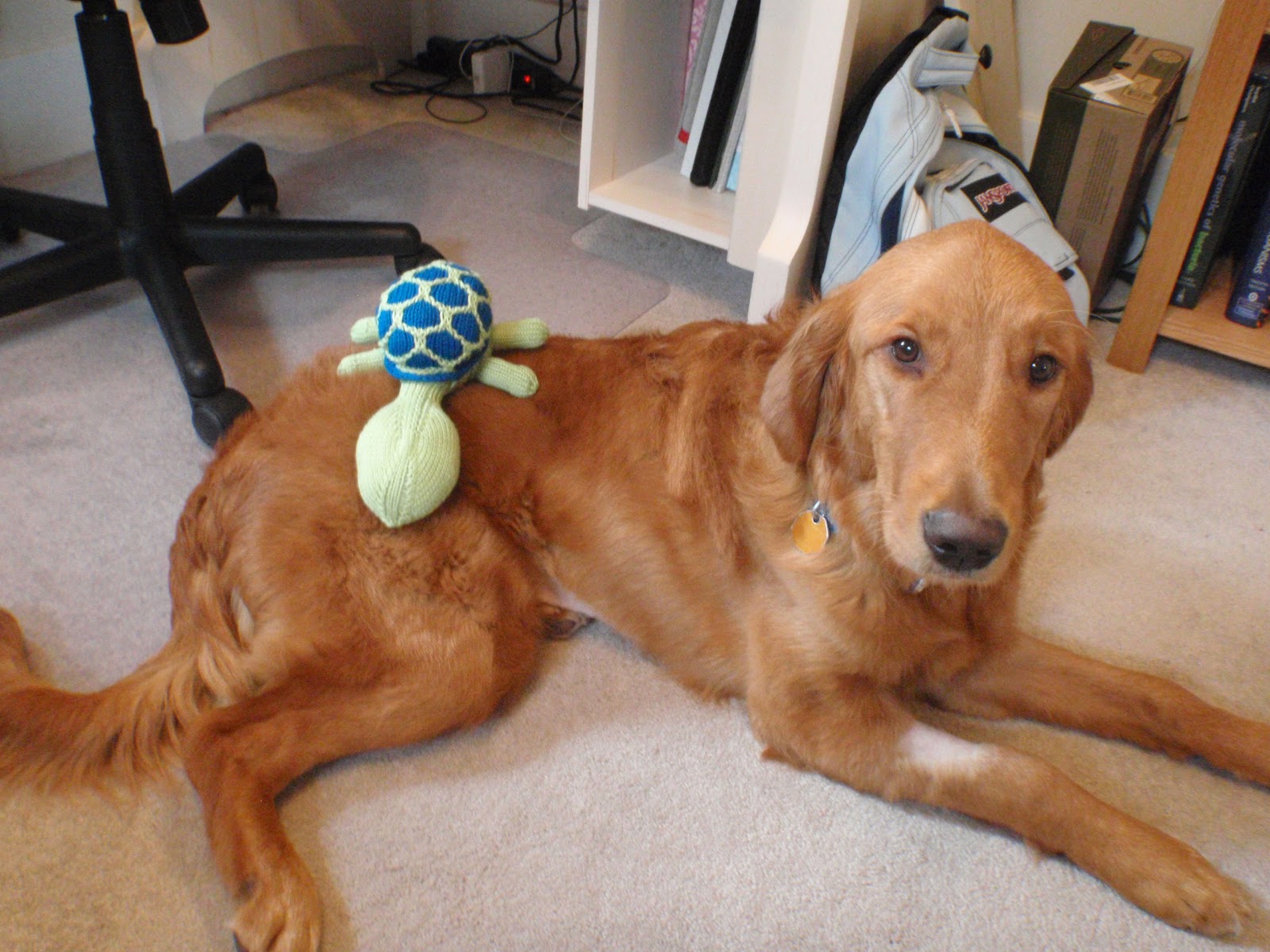
Sitting around with Abby while she recovered (since we couldn't play or take walks for most of the time), I got a lot of knitting done!  I finished 2 more baby gifts for a friend, a cute frog bib and the most adorable stuffed turtle toy ever!  The turtle took a lot of time, and I'll probably never make another (the shell was pretty complicated to put together), but I love how he turned out!!  There's some pics of older projects too, plus the roving that I just spun up.

Fingerless mitts I made over spring break.

Baby hat made with the leftover yarn.  I plan to add a flower or two.

My long awaited handspun convertible mittens!

Sheldon the turtle.

Abby making friends with Sheldon.

Froggy bib!

Shetland/alpaca/glitz roving I spun up.  May turn into a state fair project.

And last but not least, some llama updates.  Bluff is due in 2 weeks, though my mom swears she's going to have the cria before her due date.  She's huge, so I'm sure the cria is plenty big.  Now to get started on picking a name...the theme is mountains since the dad is Ridge Runner.

Bluff and her 2010 cria, Lily.  Lily is the cria that we lost to a dog attack January 2011.  Bluff's new cria will be a full sibling to both Lily and Bluff's first cria Rainier.

The same day as Bluff is due also marks the start of our show season for 2012!  The summer may be rather sparse, but I'm anticipating a busy fall!  I'm going to post a show season preview soon!

Ralph and T (the two red guys in front) are my main show string for this year!

Saturday, March 31, 2012

Puppy Post!

Since I'm currently away from the farm in grad school, its often hard to come up with llama-related topics to write about!  (That will change this summer though, can't wait!)  So I decided tonight to write about the topic that is near and dear to my heart, and the one I currently think about the most on a daily basis...my adorable puppy, Abby!

The weekend I brought Abby home...she was so tiny!

As I mentioned before, I got Abby back in October as a 9-wk old pup.  She is a full-blooded Golden Retriever, and a gorgeous girl if I do say so myself!  The first several weeks with Abby were filled with the typical puppy problems...housetraining and crate training.  Luckily Abby has never been much of a chewer, so destroying the house wasn't an issue.  She actually took to her crate pretty well too, but housetraining was a whole other matter!  Abby drinks more water than any dog I've ever seen, so she constantly needed to go outside.  She learned to ring a bell on the door when she wanted to go out though, which did help.  Now, at 7 months of age, she's a lot more reliable in the house, only having accidents if she gets over excited (as in when she meets someone new or plays really hard).  And she can sleep for 12 hours in her crate at night, which is awesome!

Abby and Hank (my roommate's German Shorthair Pointer).  February 2012.

Pretty soon after I brought Abby home we started in a "puppy kindergarten" obedience class.  Abby was the youngest in the class, but did very well.  We worked on the basics: sit, stay, lie down, come, and walking on lead.  Abby even passed her AKC Star Puppy test with flying colors!  The "advanced puppy" class this winter was a bit more challenging though.  We worked on more extensive stays (especially with distractions) and heeling, as well as brushing up on the basics.  At the end of this class we took the AKC Canine Good Citizen (CGC) test, but no one ended up passing.  It was a lot harder than the puppy test!  I'm planning on continuing to work with Abby over the spring and summer though, and try to pass the test again in the fall.

Abby and Hank "playing".

Now that Abby (and I) have gone through some pretty extensive obedience work (and know what we need to work on and how to accomplish the goals I have for her), I decided it was time for something more fun!  I wanted to do an intro to agility class with her, but it didn't work out so we signed up for flyball instead!  Flyball basically involves the dog running over a set of low jumps, retrieving a tennis ball from a box-like contraption, and then running back to the handler.  There are competitions where it is like a doggy relay: a team of dogs runs back and forth over the course as fast as they can.  Check out YouTube for videos if you haven't seen flyball before, it is amazing!  We have only been to 2 classes so far, but it seems like Abby is quite a natural.  She has no problems with the jumps, and isn't afraid of the box at all.  Now she just has to learn to grab the tennis ball and bring it back, she tends to get distracted!  Hopefully I'll be able to work on that at home, once she heals up a bit more.

Which brings me to my next topic...miss Abby got spayed last Wednesday.  After losing 2 dogs to reproductive cancers (including a Golden Retriever), I knew I wanted to have her spayed before she came into heat the first time.  The vets at the MSU Vet Hospital where I take Abby said she could be spayed anytime after her last round of shots at 4 months of age, but I decided to wait for her to grow a bit more, and she was spayed a few weeks after her 7 month birthday.  She's currently 3 days post-surgery, and has completely bounced back to her normal self.  That's a good and a bad thing...I'm glad to know she is on the mend, but its hard to keep an energetic 7 month old puppy quiet for 10 days!  She's being confined to my room when I'm home, and in her crate when I'm at school.  She has clearance to start going on walks again after 7 days, and can play as normal after 10.  And we get to go back to flyball after 14 days!

February 2012.  She's getting big!

This summer we're going to take an agility class back home in Indianapolis.  We're skipping the intro class and starting in the beginner class, so Abby and I will have some pre-class "homework" to work on before we start!  It should be a lot of fun though.

How could you resist that face?  She definitely has the "guilty" eye thing going already!  Christmas 2011.

Maybe I'll start doing "Abby Updates" every once in awhile.  So for March 2012:  Abby is 7.5 months old, weighs in at 48 lbs.  She's as tall as my parents' Australian Shepherds, but not quite as tall as my roommate's German Shorthair Pointer.  I think she's had 2 accidents in the house in the past month.  As far as obedience goes, she knows how to sit, lie down, and stay (with minimal distractions) very well.  We're still working on heeling, loose lead walking, and coming when called (though she has gotten a lot better about coming!).  My current flyball goal for her is to learn to grab the tennis ball off the box and bring it back.  My overall training goal is to get her to quit jumping on people when she meets someone new!

Tuesday, March 20, 2012

Llama Biography #5: Alder Crest April Showers

Finally I get to brag about my girl, April!  April is one of my all-time favorite llamas, somewhat because she is so beautiful but mostly because of the journey we have made together.

April as a cria, Spring 1994.

April as a yearling, Spring 1995.  She was born on a farm in Oregon, and was purchased by Casa Loma Llamas at an auction.


April as a 2-yr-old, 1996.


April's dam, CLR Ramona.  Hard to believe a light-wool llama could have such a wooly cria as April!


Can you see where April got her looks?  This is her sire, LW Regalo (a LW Kissam son!).  Very strong black and white bloodlines from this side of her family!


Casa Loma's Chantilly Lace, April's first cria.

April came to our farm in February/March 2000.  She was sort-of a rescue, coming from Casa Loma Llamas who was going out of business at the time.  Her owner was down to just a few llamas, including April (who was bred) and her daughter, Rhapsody (Casa Loma's Rhapsody in the Rain).  So we took both April and Rhapsody to our farm, and a few months later, April gave birth to May (Little May Flowers) (of course, April Showers brings May Flowers!).  May was the first cria to be born on our farm...we came home from school/work one day and there she was!  Luckily April was a great mom, and May grew up to be a beautiful girl.

Casa Loma's Rhapsody in the Rain, April's third cria.


Little May Flowers, April's first cria on our farm.


A few months after May was born, one of the two lumps on April's neck burst open, and she went to Ohio State University to get checked out by the vet.  (Back story: April's previous owner's vet used to give shots in the neck, and the owner suspects that a needle tip broke off and got stuck in April's neck, and then tissue built up around the object, forming the lumps.)  They ended up lancing the lumps and removing all the material, and sent her home with instructions to give her antibiotic shots and clean out the wounds.  Well April is a very powerful llama, and she quickly made mincemeat out of our cattle chute that we had been using to hold the llamas for medical procedures.  Luckily friends of ours made and sold steel llama chutes, so we made our most important investment to date and bought a new chute.  April can still move it a few inches if she lunges, but at least she can't hurt herself or us!  The lumps are now completely healed and you would never know that she had them!

Such a wooly girl!


Almost two years after May was born I took April to her first show, the Western Ohio Triple Crown.  She hadn't been shown in about 7 years, but we entered a competitive halter class (Heavy Wool Adult Female), and we got a first and a second (double show=2 placings)!  It was definitely one of my proudest moments showing!

April and I at the Western Ohio Triple Crown, Spring 2002.


In 2001 we took April to a neighboring farm to get bred to one of their gorgeous males.  True to her dominant personality, April ended up attacking the male one day, as the owners were checking to see if she was bred.  A year later (and also while no one was home!) April gave birth to a little boy, Autumn Hill's Tatoka.  This guy was running from the start, hence his name (Tatoka means "antelope" in Lakota Indian). Tatoka was sold to a friend as a fiber/pet llama, and it is remarkable how much he looks like his mom now that he is full grown!

Autumn Hill's Tatoka, Fall 2002.


Since April did so well at the show in spring of 2002, we decided to take her to the Great Lakes regional that fall.  Tatoka was just 2 weeks old when we took him and April up to the show.  Once again April was amazing to show, she won her halter class again (beating the female who went on to be the National Champion!), and came in 3rd in the top 5 of the wool division.

April and I at the 2002 Great Lakes Regionals.  Look at that presence!


We tried for awhile to get April bred again after Tatoka was born, but due to a few young (unproven) males who didn't really know what they were doing, she never ended up pregnant.  We bought an older, proven male in 2004, and bred April along with the rest of our females to him.  In the fall of 2005 April gave us another awesome boy, Autumn Hill's Inali.  (Inali means "black raven" in another Native American language.)  Inali was also a spitting image of his mom (at least in his build and wool coverage), and was a fun show boy for me one summer.  He was sold to a horse farm after he was weaned, and is now best friends with a horse and a peacock!

April after a much-needed body cut!


The fiber grows back really quick though!  (This was about 2 years after her full body cut.)


Autumn Hill's Inali, with April in the background.


Inali and his horse friend, Snuffy.


After Inali was born we again tried to breed April (this time to a really famous male at a neighboring farm), but apparently she was done being a mom.  She attacked several males, so we let her retire from breeding.  I had so much fun showing April in the past, I decided to start showing her again now that she wasn't having crias for us.  I showed her off and on during 2005-2010.  We even did a few performance classes in 2010 (without any training), and she did better than one of the crias I had actually trained to do obstacles!

April and I winning Younger Adult Showmanship at the Ohio State Fair.  She was a fabulous showmanship partner, once she realized the judge wasn't going to kill her and after I got her clean!


Indiana State Fair.  I think we were 3rd in a huge Adult Showmanship class that year too!


2010 Lama Fest.  I screwed up in showmanship at this show, so we didn't do as well.


In 2010 and 2011, I took a big leap and started training April to cart drive.  At this point she was about 16 years old, but still in amazing shape.  She's extremely smart and very curious, so I thought she'd be a great driving partner.  During the summer of 2010 we worked on ground driving (driving without a cart, just walking behind the llama).  April picked it up really quick, I was truly impressed!  In April 2011 I had the opportunity to attend a cart driving workshop in Ohio, so April and Bluff came along.  April did great when driving a triple hitch with 2 other trained llamas, but freaked out when we tried to hitch herself to the cart by herself.  Considering she's now 18 years old, I decided to give up on cart training and just let her live out her life as our fabulous guard llama.  I really wish I could have gotten another cria out of April to continue her legacy in our herd, but even without it she will never be forgotten!  I will not be surprised if she lives to be more than 25 years old!